
Master Project
The aim of the Master Project is to create a holistic and student-centred learning environment through a profound integration of artistic development with research and professional integration activities.
The educational philosophy of the Master of Music programme at the Royal Conservatoire is dedicated to developing a student’s individual artistic vision, personal growth, inquisitive and entrepreneurial attitude and independence, and their performing/creative and technical skills to a high qualitative level. To guide a stu-dent’s development, the Master curriculum encompasses three domains: artistic development – research – professional integration.
The programme is aimed at helping students navigate the complex realities of today’s music profession and find their place in the professional practice. Students are constantly encouraged to make their own choices and develop and carry out their own ideas and plans.
The Master Project challenges students during their two-year studies to connect all three domains in a way that is meaningful and relevant to them, so that they can find their ‘niche’ and prepare themselves for the professional practice.
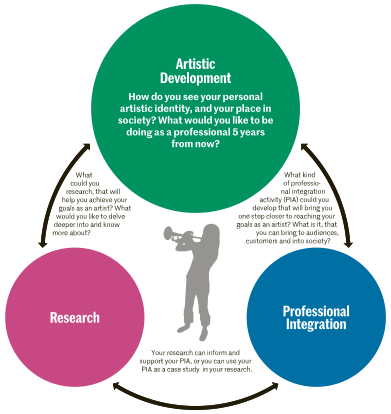
Prospective students are asked to start thinking about their future and their Master Project when they apply:
Eduardo Gaspar Polo Baader (main subject Early Music traverso) tells us about his Master Project. His research was titled ‘A Garden of Sounds and Flavours. Establishing a synergistic relationship between mu-
sic and food in live performance settings’.
‘My research was about pairing food and music in live performance settings. As part of it, I carried out several experiments that took the form of small performances for which I composed new music for traverso and baroque violin. This music, which I performed with my ensemble Celeritas, was meant to match certain dishes that were served to the audience during the experiments, and which I cooked myself.’
‘My Professional Integration Activity (PIA) consisted of a public performance called Four Bites of Autumn, which took place a total of six times in Delft in November 2022. During this performance, I used all the insights I had acquired during my research experiments to design a music and food pairing. The music was again performed by my ensemble Celeritas, and the food was prepared by the staff of the café Bij de Roos in Delft. The performance also provided a lot of interesting data which I was able to include in my research.’
‘Lastly, my artistic development on the traverso during these two years was crucial for me to be able to play the music I performed during the research experiments and the PIA. Many of my main instrument lessons were used as chamber music coaching sessions for my ensemble, which was a crucial part of both my research and PIA. Furthermore, the experiments and PIA allowed me to compose and play a lot of new music for traverso, which was one of the goals for my artistic development. The electives I chose (Historical Acting Techniques for Musicians: Imagination, Memory, Embodiment; and Improvisation: From Score to Creation. A European Joint Module) rounded off my artistic development, helping me become a more communicative and engaging performer.’
‘I have found the division of the Master’s curriculum into artistic development, research, and professional integration very helpful. It provides a clear and simple framework within which I have been able to easily place all the artistic activities I have carried out during these two years. I now think of the three categories that comprise this framework as different perspectives from which I can look at my practice, and not as separate entities. Thinking in this way allows me to regularly check whether my artistic practice is developing in an organic and healthy way, or whether I am neglecting a part of it. I also find it helpful when trying to decide whether to join a particular project I am asked to participate in.’
Click here for the Master Project Plan Guidelines.